
The Secret Tube Tour Every Culture Lover Should Book
Most visitors to London see the Underground from one angle only: standing on a crowded platform, waiting for the next train. But beneath the city’s streets lies a quieter, stranger version of the Tube network, full of disused stations, forgotten passageways and rooms that once housed wartime offices. For travellers who like their history with a bit of theatre, this is where London’s lesser-known story gets told.
That’s the appeal behind the London Transport Museum’s Hidden London tours, a series of guided walks that take small groups into parts of the network the public never usually sees. We joined one of the newest additions to the programme, a tour of the old Dover Street station, to find out what makes it worth the detour from the usual sightseeing trail.
What exactly is a Hidden London tour?
If you’ve not come across them before, Hidden London tours are run by the London Transport Museum and led by guides who clearly relish the material. Rather than a quick history lecture, they’re physical, atmospheric walks through old tunnels, lift shafts and abandoned platforms.
Past tours have explored Clapham South, which served as an air raid shelter during the Second World War, and Aldwych station, closed to passengers for the last 30 years. The newest tour, Dover Street: Alight Here for Green Park, takes a different site and a different story: a station that didn’t close so much as transform.
Here’s the context worth knowing before you go: Dover Street station opened in 1906 to serve the Great Northern, Piccadilly and Brompton Railway, which is now better known as the Piccadilly line. In its original form, it would have had the look typical of stations from that era, designed by architect Leslie Green, with oxblood red tiles and arched windows along the exterior.
The station didn’t stay as Dover Street for long, at least not in name. In 1933, it had a significant makeover. Lifts were swapped for escalators, the entrance moved to sit beside the Ritz hotel, and the station reopened as Green Park, the stop millions of commuters and visitors use today without a second thought about what came before.
The tour’s most surprising chapter has nothing to do with trains at all. During the Second World War, the old station was converted into offices and living quarters for the London Transport Executive Board, effectively becoming a wartime headquarters underground.
It wasn’t a cheap job either. The board’s chairman at the time, Lord Ashfield, apparently insisted on a few personal comforts, including a proper skirting board and a wallpapered bedroom, even several storeys below street level. It’s an odd detail that says a lot about how seriously this hidden world was taken, and it’s easy to imagine staff working shifts that stretched over several days without once seeing daylight.
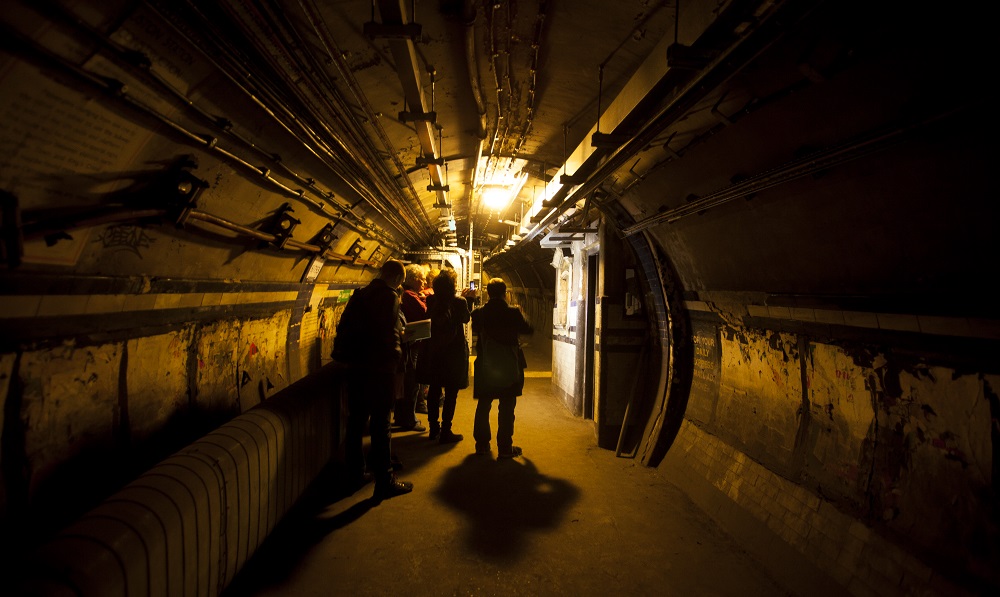
On the tour itself, you move through a maze of sooty former passageways and old lift landings, past vintage signage still pointing “To The Trains”. At points, you can look down through overhead grilles and watch a live Tube train pass directly beneath your feet, a reminder that the ordinary Piccadilly line is still running just metres away.
One stretch involves heading down a steep staircase enclosed in a metal tunnel, the kind of setting that wouldn’t look out of place in a science fiction film. The tour builds toward one of the old ventilation shafts, a vast steel structure you can look straight up through, with daylight visible far above. It’s a genuinely dramatic way to end the walk, and a striking reminder of just how much engineering sits beneath the capital’s pavements.
Booking details and good to know
The Dover Street tour runs for around 80 minutes. Tickets cost £45 for an adult, and the tour isn’t suitable for children aged 9 and under, largely because of the uneven surfaces, stairs and confined spaces involved.
Your ticket also includes half-price entry to the London Transport Museum itself for one day, valid within a month of your tour date, plus a 10% discount at the museum shop. Profits go toward the museum’s charitable work preserving London’s transport and design heritage, so it’s a meaningful way to spend an afternoon as well as an interesting one.
Why it’s worth seeking out
For anyone drawn to London’s layered history, a Hidden London tour offers something the big-name attractions can’t: a sense of discovering a place that millions pass by every day without knowing it’s there. Having travelled the Tube network for years ourselves, seeing Green Park station’s hidden past up close changed how we’ll look at that platform the next time we’re waiting for a train.